Agata May’kowska Art at the JCC in Bridgewater: A Mixed Media Exhibit of Texture, Faith, and Memory
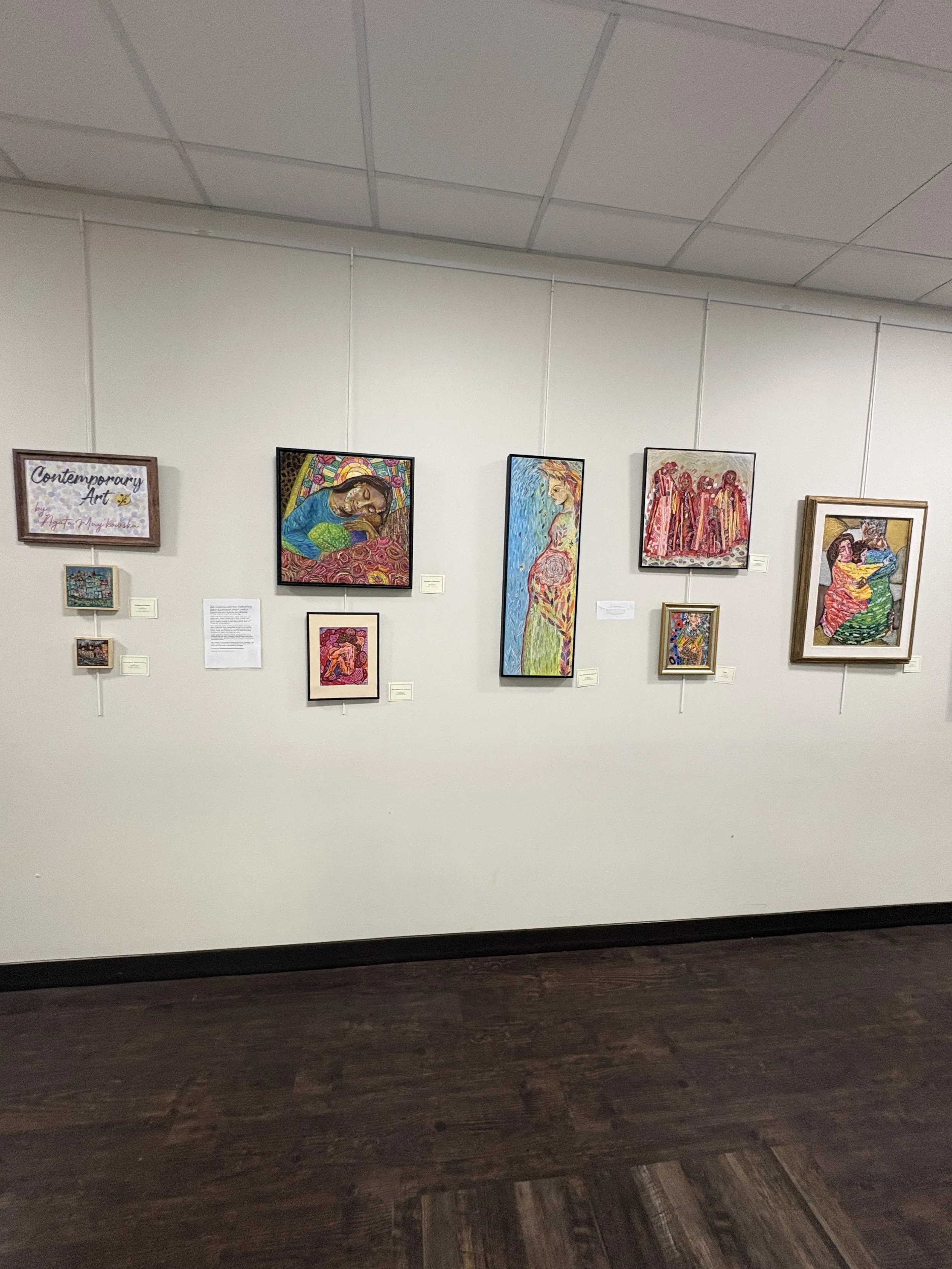
I am honored to share that a selection of my original mixed media artwork is now hanging at the Shimon and Sara Birnbaum Jewish Community Center in Bridgewater, NJ, through the end of August 2026.
For me, seeing these pieces placed in a community space is deeply meaningful. Art is not only made for walls. It is made for encounter. It waits quietly, then meets people in the middle of their ordinary day — while they are walking down a hallway, bringing children to class, visiting with friends, or simply passing by and suddenly feeling invited to pause.
That is what I hope my art does.
About the Artist: Agata May’kowska of WholeHeartedARTS
My name is Agata May’kowska, and I am the founder and lead artist behind WholeHeartedARTS. I was born in Poland and have lived in Mercer County, New Jersey since 2005. My work is shaped by faith, healing, beauty, suffering, remembrance, joy, and the quiet places where the human heart keeps becoming whole.
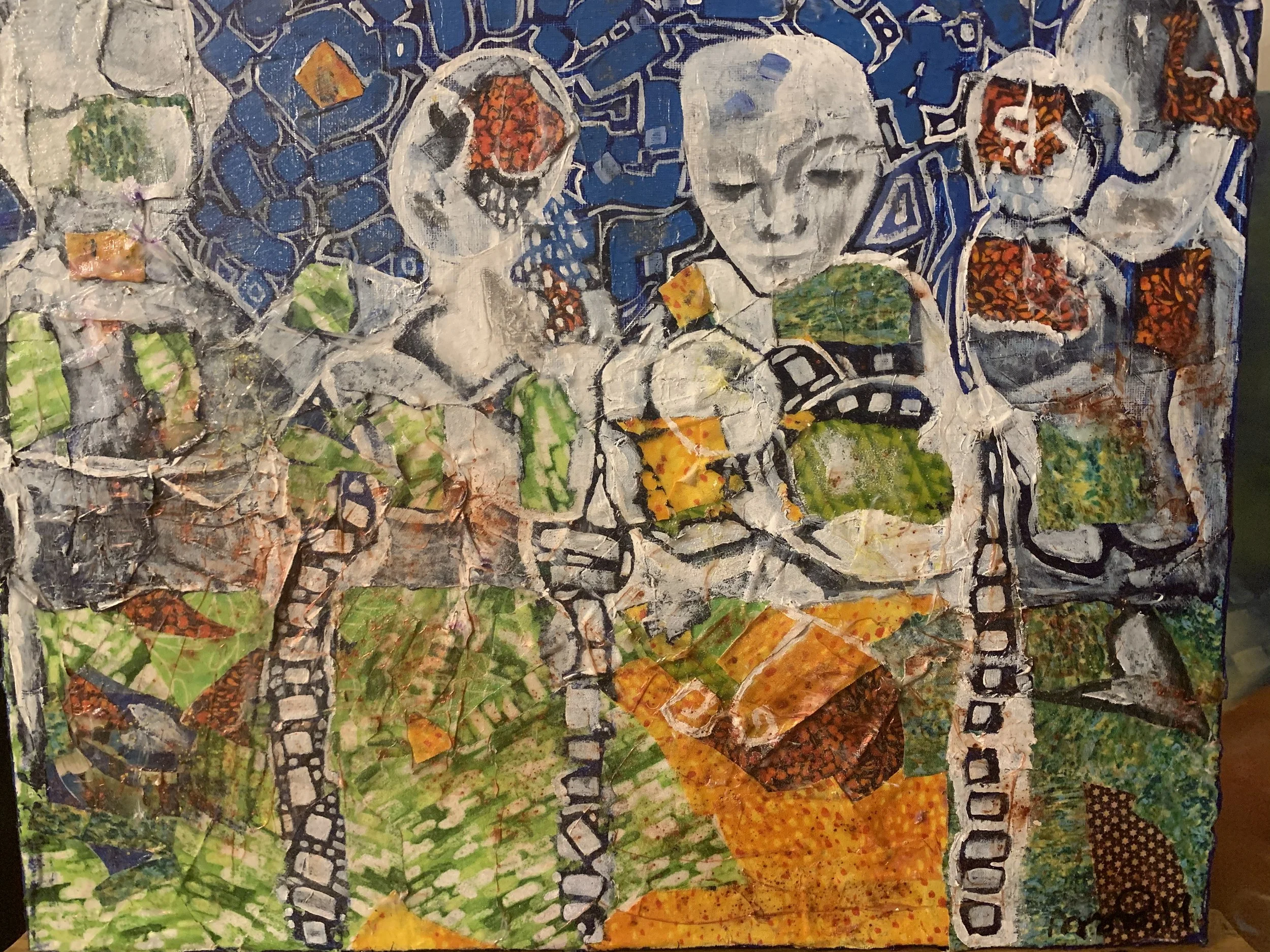
I am also a partially blind artist, which has changed the way I create. Over time, my art became less about perfect sight and more about presence, texture, memory, and touch. I work with layered materials such as fabric, acrylic, paper, metal, glass, mirror, and other mixed media elements, building each piece slowly until it carries not only color, but emotional and spiritual weight.
At WholeHeartedARTS, my work is created for collectors who want more than decoration. These are original, one-of-a-kind pieces made to bring texture, meaning, and presence into homes, offices, sacred spaces, and community settings.
Why This Art Belongs in a Community Space
The JCC in Bridgewater is a place where people gather — families, children, seniors, neighbors, and friends. That matters to me.
Many of my paintings are about what we carry as human beings: memory, longing, grief, courage, motherhood, faith, hope, and the strength to keep walking. Some pieces are joyful and whimsical. Some are more reflective. Some hold sorrow gently. Some feel like prayer. Together, they tell a story about the human spirit and the beauty that can still rise from complicated places.
In a community center, art becomes part of shared life. It does not sit apart from people. It enters the rhythm of the building. It becomes something someone may notice once, then return to again. It may speak differently on a hard day than it does on a joyful one.
That is one of the reasons I love creating textured mixed media art. Texture asks people to come closer. It reminds us that life itself is layered.
A Collection Rooted in Texture, Faith, and Emotional Depth
The works now hanging at the JCC represent the heart of WholeHeartedARTS: original mixed media art rich in texture, meaning, and presence.
Some pieces come from a place of remembrance. Others from gratitude, endurance, motherhood, wonder, and quiet hope. Many of them carry my ongoing artistic language — layered surfaces, symbolic forms, movement, fragments, hidden details, and a sense that something deeper is happening beneath what is first seen.
My art often asks:
What do we remember?
What do we carry?
Where does healing begin?
What remains when life changes us?
How can beauty help us keep our hearts open?
These questions are not always answered directly. Sometimes they are held in color. Sometimes in texture. Sometimes in a small figure, a key, a wall, a window, a flower, or a line that feels like it has survived something.
Visit the Art at the JCC in Bridgewater, NJ
If you are local to Bridgewater, Somerset County, Mercer County, Princeton, or the surrounding New Jersey area, I would love for you to visit the JCC and see the work in person.
Photographs can show color and composition, but mixed media art is different when experienced closely. The raised surfaces, fabric, layered paint, reflective details, and physical presence of the work are part of the story.
The exhibit is on view now through the end of August 2026 at:
Shimon and Sara Birnbaum Jewish Community Center
775 Talamini Road
Bridgewater, NJ 08807
Collecting Original Art from WholeHeartedARTS
Many of the pieces displayed at the JCC are available to collect. If a work speaks to you, you are welcome to inquire directly through WholeHeartedARTS.
Collectors often tell me they are drawn to the emotional honesty of the work — the sense that the painting is not just matching a room, but entering it with meaning. That is always my hope. I want my art to bring beauty, yes, but also depth. I want it to become part of the life of a home.
Original art carries the hand of the artist, the season in which it was created, and the story it continues to tell after it leaves the studio.
A Personal Thank You
I am grateful to have my work hanging in the Jewish Community Center in Bridgewater. It is a gift to see these pieces leave the studio and enter a place where people gather, remember, grow, learn, and live.
May the art bring beauty to the walls, but also small moments of reflection to those who pass by.
And may it remind us that even in a noisy world, meaning can still be found — sometimes quietly, sometimes in layers, sometimes right in front of us.
Where Memory and Meaning Meet
Where Memory and Meaning Meet is a reflective collection exploring remembrance, human suffering, inner freedom, and the search for meaning in places marked by sorrow. Through symbols of walls, doors, witnesses, and keys, these works honor the dignity of the human spirit and the quiet light that refuses to be extinguished.
A Collection on Remembrance, Suffering, and the Inner Key We Carry
Some paintings begin with color. Some begin with texture. Some begin with beauty.
This collection began with weight.
Where Memory and Meaning Meet is a collection through which I reflect on human suffering, remembrance, inner freedom, and the search for meaning in places marked by sorrow. It is not a collection created to decorate silence, but to enter it gently — to stand before it, to listen, and to remember.
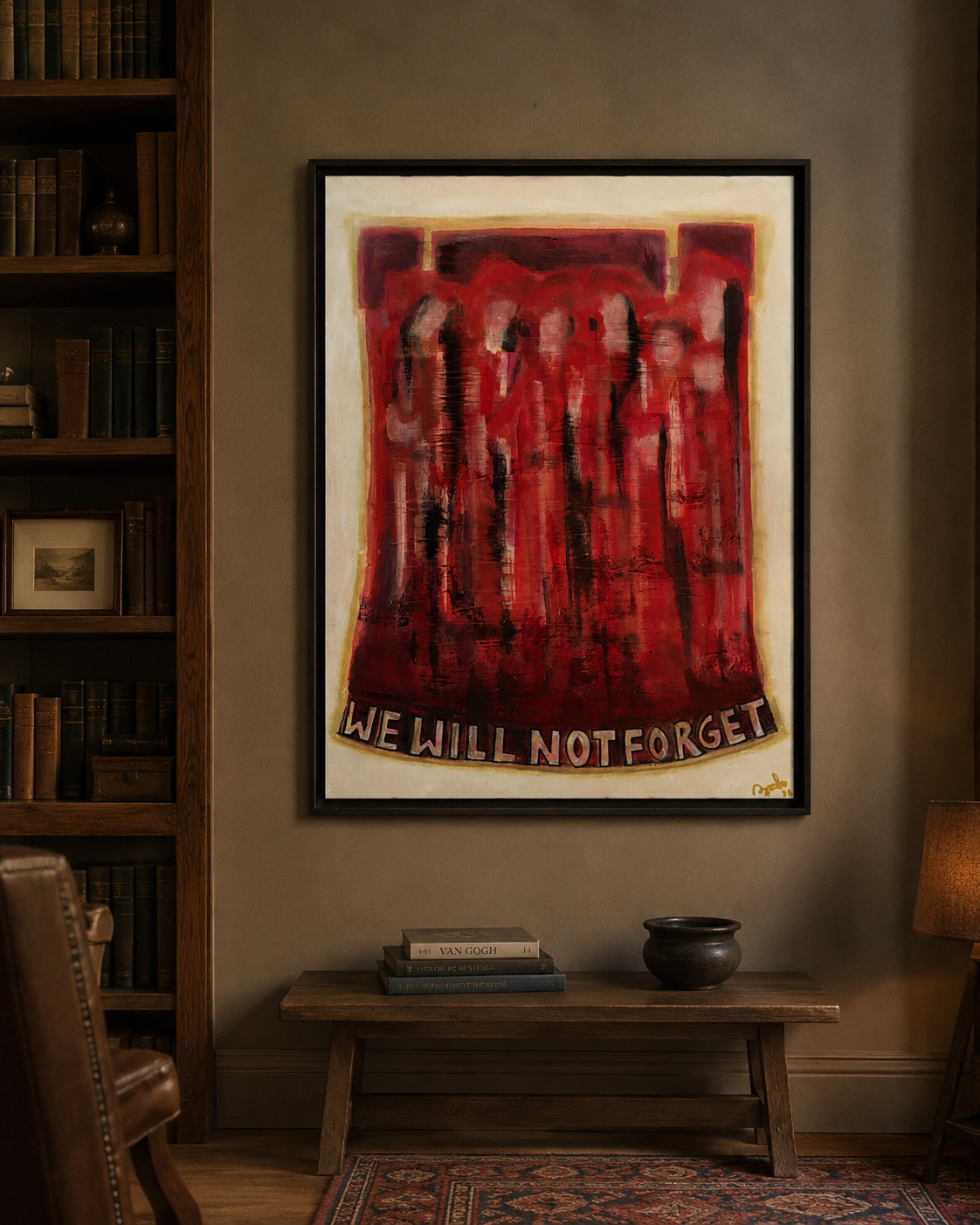
The first work, Where the Walls Remember, carries the words We Will Not Forget. It was created as a memorial — not only to the victims of Auschwitz, but to every human life crushed by cruelty, hatred, indifference, and evil. The painting asks us not to look away. It reminds us that remembering is not passive. Remembering is an act of honor. It is a refusal to let suffering be erased.
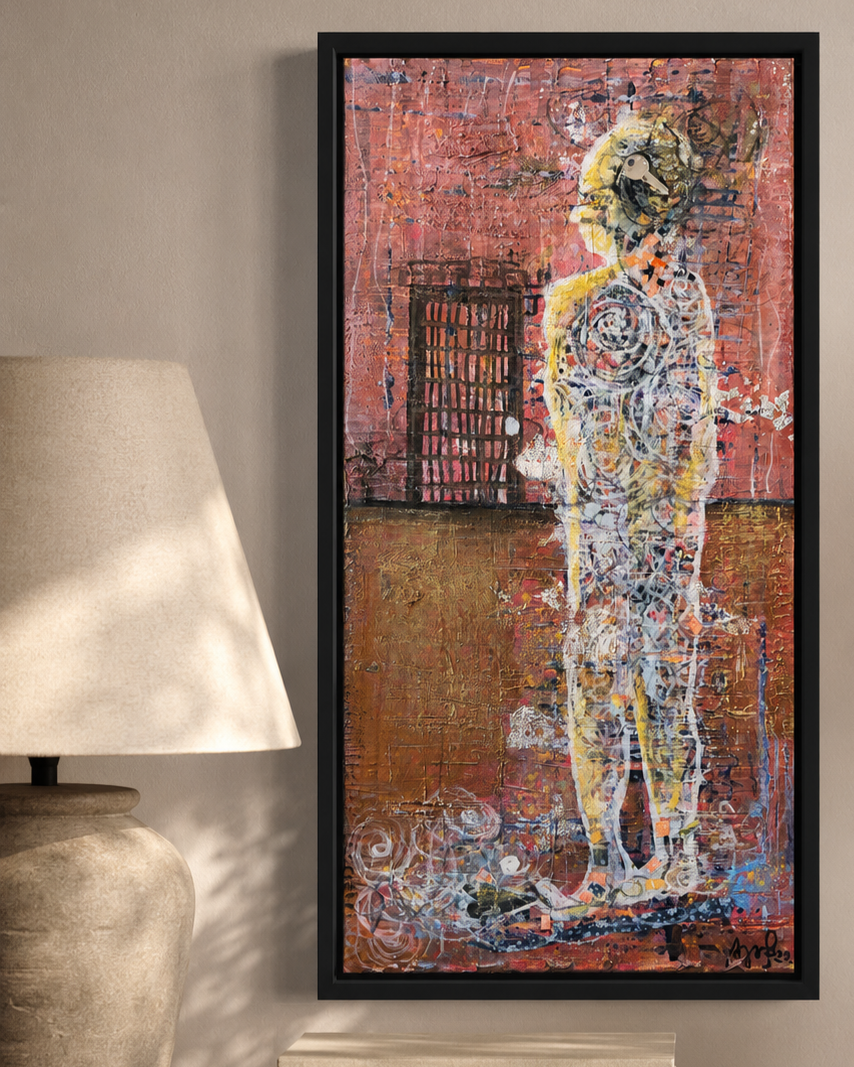
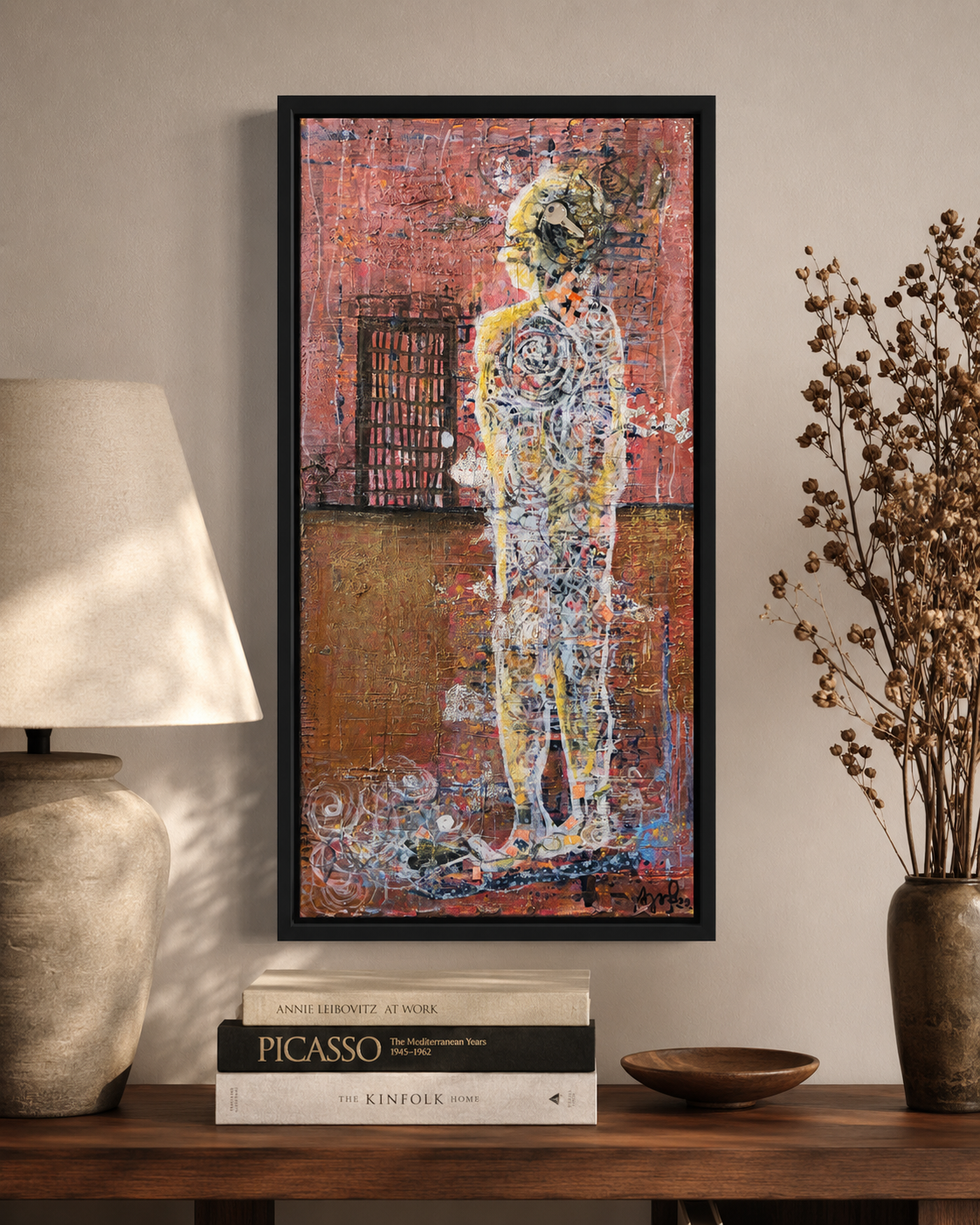
The second work, The Key Within, was inspired by Viktor Frankl’s Man’s Search for Meaning. In this piece, a solitary figure stands before a barred opening. There is a sense of confinement, but also a quiet presence of dignity. A small key appears within the figure — a symbol of the hidden place inside us where courage, grace, conscience, faith, and meaning can still remain alive.
Frankl wrote, “When we are no longer able to change a situation, we are challenged to change ourselves.” That truth sits at the heart of this work. The door may be closed. The walls may be real. But there is still something within the human spirit that cannot be fully taken away.
Together, these paintings hold a sacred tension: the reality of suffering and the mystery of endurance.
They reflect on walls and doors, memory and silence, grief and meaning. They ask what remains when everything external is stripped away. They honor those who suffered, while also pointing toward the inner life — the place where hope, faith, and dignity refuse to be extinguished.
As an artist, I do not want to make suffering look beautiful in a shallow way. I want to create work that holds suffering truthfully, with reverence. I want the texture, the red, the marks, the figures, the walls, and the keys to become visual prayers — reminders that human life is sacred, that memory matters, and that even in darkness, meaning can still be found.
Where Memory and Meaning Meet is not an easy collection. But it is an honest one.
It is my way of standing before history, before pain, before the mystery of endurance, and saying:
We remember.
We honor.
We search for meaning.
And we hold the key within.
What Remains After the Storm
Some paintings do not speak in a loud voice.
They sit quietly.
They wait for you to come closer.
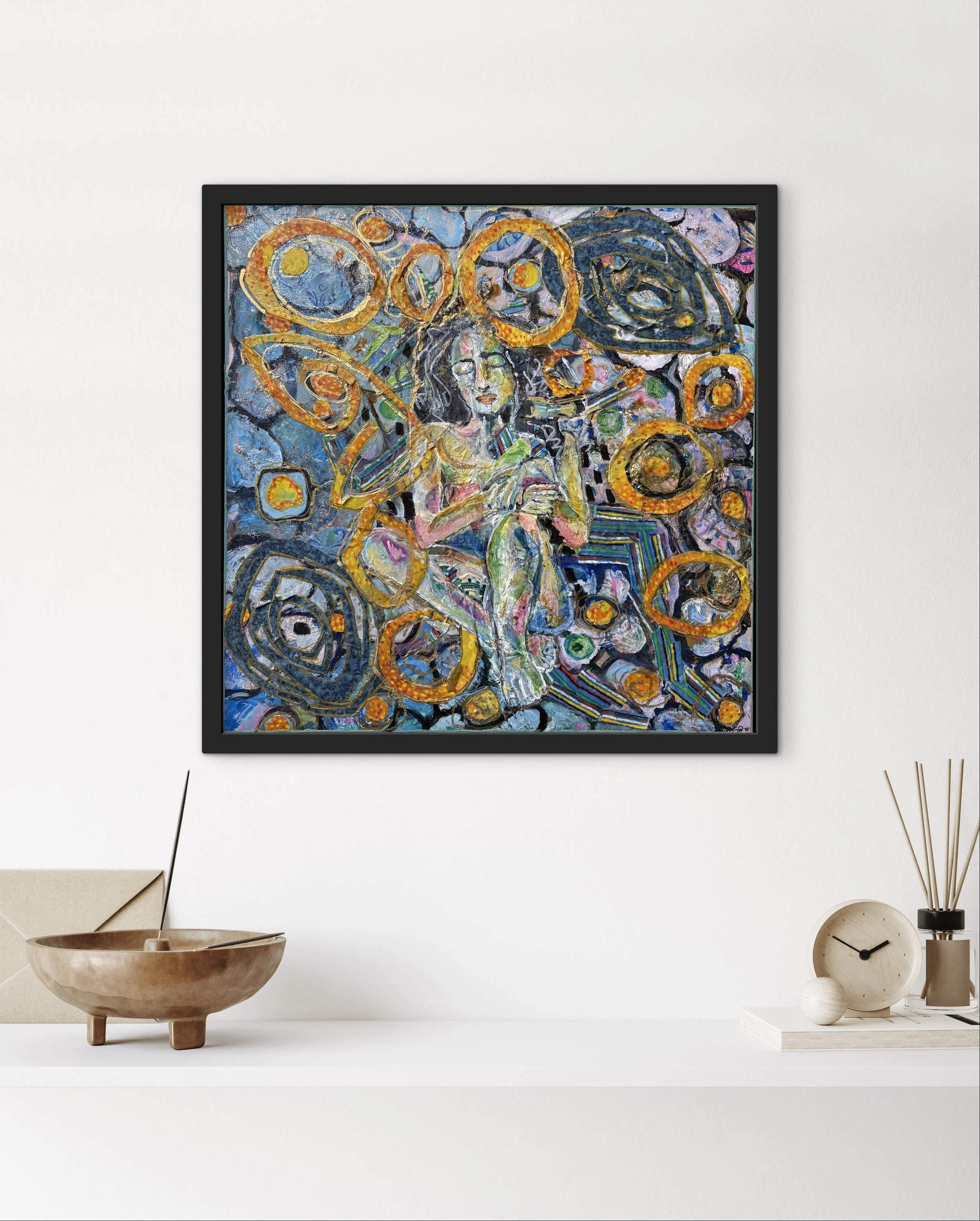
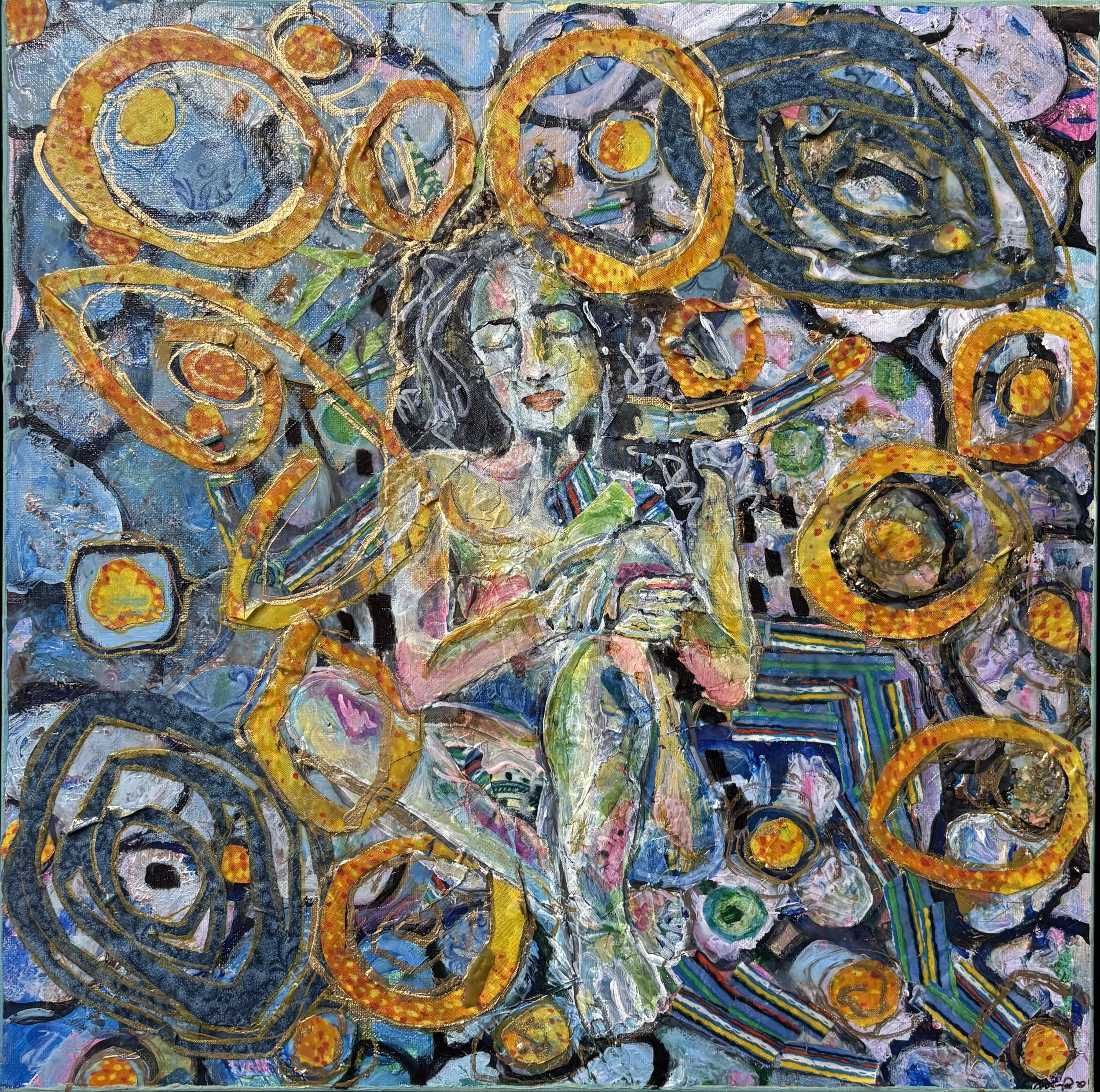
This painting feels like that to me. At first, it may seem full of movement — circles, layers, marks, color, eyes, fragments of light. But the longer I look, the more I do not see chaos. I see endurance. I see a soul that has learned how to remain.
At the center is a figure who feelsS still, almost prayerful. She is not defeated. She is not disappearing. She is surrounded by all the movement of life, all the things that have happened, all the memories and moments and questions — yet she remains present.
There is something deeply wise about her.
Not the kind of wisdom that comes from books only, but the kind that comes from surviving. The kind that is formed slowly, through waiting, through loss, through beginning again, through carrying what could not be changed and still choosing to live with tenderness.
The circles around her feel like time. Seasons. Years. Generations. The many eyes of memory. The things she has seen, and the things that have watched over her. Some are bright, some are shadowed, some are imperfect, but all of them belong to the story.
This painting reminds me that human suffering is not only about what breaks us.
It is also about what grows in us when we refuse to become hard.
Patience is not weakness. Sometimes patience is survival. Sometimes patience is the quiet courage to keep breathing when life does not make sense. Sometimes it is the strength to sit inside uncertainty without surrendering your soul to bitterness.
Wisdom often looks gentle from the outside, but it is not fragile. It has passed through fire. It has learned what matters and what does not. It has stopped chasing noise. It knows how to recognize light, even when the light is small.
That is what I see here.
A woman surrounded by memory, but not imprisoned by it.
A soul marked by life, but not erased by it.
A quiet center in the middle of many turning circles.
The gold in this piece feels important. It does not cover everything. It does not pretend that darkness was never there. It moves through the painting like evidence of grace — small, bright, stubborn, alive.
Maybe that is what survival becomes at its most beautiful.
Not a denial of pain.
Not a performance of strength.
But the sacred ability to remain human after life has asked too much.
This painting is about patience that has depth. Wisdom that has been earned. Survival that still carries beauty. It is about the human spirit learning how to sit in the middle of all that has happened and still hold light.
And maybe that is its quiet message:
We are more than what happened to us.
We are also what endured.
What softened instead of hardened.
What remembered and still loved.
What survived and became wise.
More Than Beautiful: How Textured Art Transforms Every Space
What transforms a room from beautiful to truly alive? Original textured art — work made by human hands, built layer by layer, carrying not just rich visual depth but genuine emotional and spiritual presence. In this post we explore why texture is the unsung hero of interior design, and why the art you live with every day matters more than you think.
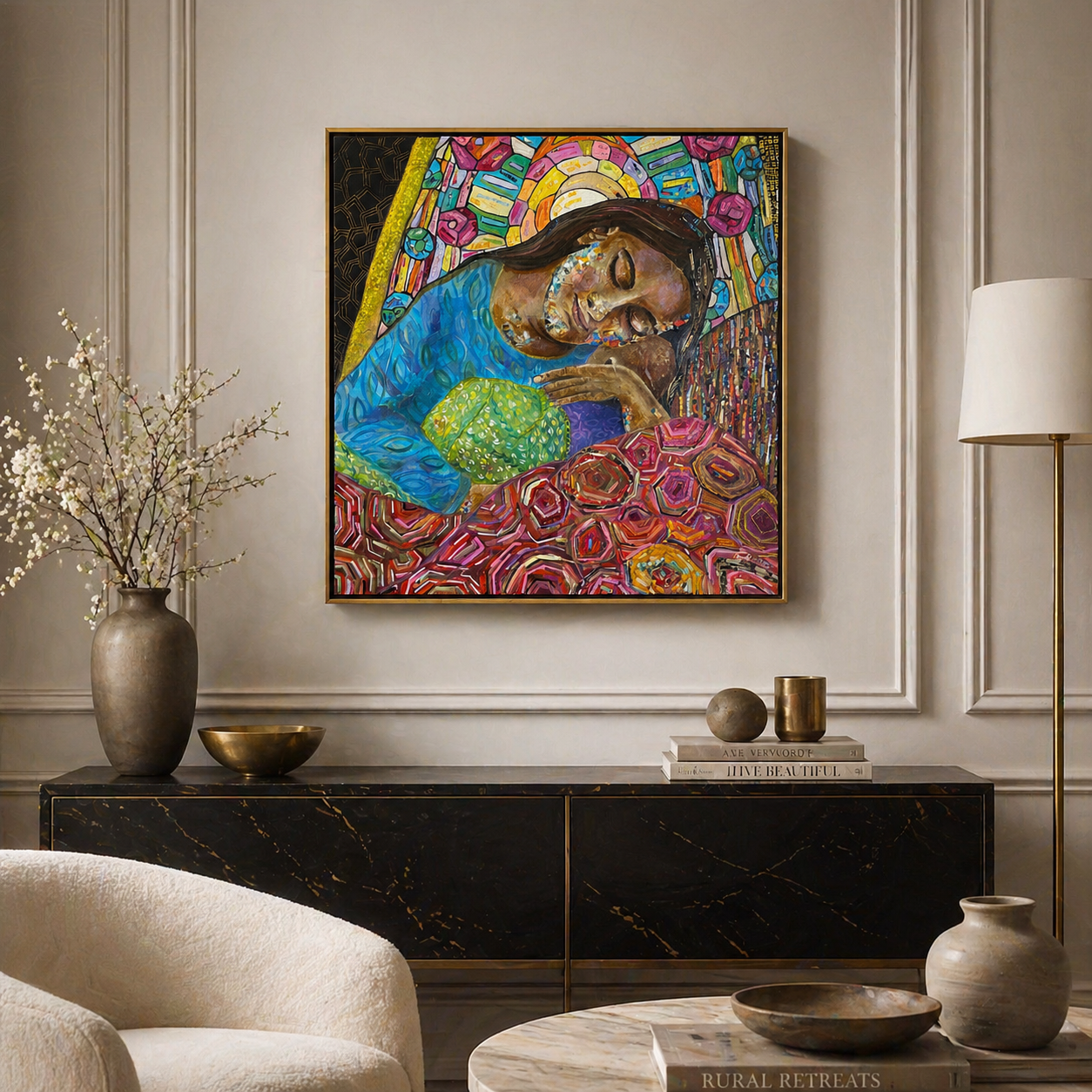
Why the walls you live with matter far more than you think — and how original textured art can uplift a room, a mood, and even a spirit.
"A room feels flat. Something is missing — not furniture, not color, but a certain aliveness. More often than not, what a space truly needs is texture."
You've rearranged the furniture. You've repainted the walls. You've added cushions, switched the lighting, brought in plants. And yet the space still doesn't feel quite right — it doesn't breathe, doesn't hold you, doesn't feel like yours. Interior designers have long understood the secret that most of us discover only by accident: what transforms a room from beautiful to alive is texture.
But textured art isn't merely a design trick. The best of it carries something far more precious — an emotional resonance, a handmade humanity, sometimes even a quiet spiritual presence that changes not just how a room looks, but how you feel inside it.
Part One
Texture Is the Unsung Hero of Interior Design
We often speak of decorating in terms of color and form, but texture is the element that makes a space feel inhabited. It is, as designers at Casa Amarosa put it, the unsung hero — a subtle yet powerful tool that can completely alter the atmosphere of a room. Texture creates depth, interest, and that irreplaceable sense of richness that no flat surface can replicate.
When light falls across a raised surface — a thick impasto brushstroke, a ridge of modelling paste, a layered sweep of mixed media — it casts shadows. Those shadows shift with the time of day. Your art looks different at noon than it does at dusk. It becomes a living thing within your home, dynamic and ever-present, never static.
Interior design experts note that textured art adds a tactile dimension to a space, inviting a sensory experience that goes far beyond visual appeal. It draws the eye, anchors the room, and sets the emotional tone for everything around it. Unlike mass-produced prints — identical copies of identical images — a piece of original textured art is singular. The mark of the artist's hand is preserved in every ridge and groove.
"Textured elements can enhance the sensory experience and make the environment feel more inviting — natural materials like wood, stone, and layered art have a calming, grounding effect that transforms not just aesthetics but wellbeing."
— Source: Bright Life Studio · "Choosing Healing Art to Create Spaces that Nurture, Uplift and Inspire"
Part Two
Art as Emotional Architecture
There is a growing body of understanding around what researchers and designers now call healing art — work created with the intention of supporting holistic wellness. This isn't mystical thinking; it is rooted in the observable truth that when we are emotionally grounded and at ease in our environments, our stress levels fall, our minds quieten, and our capacity for joy expands.
Art in interior design offers emotional touchpoints — pieces that resonate with personal meaning, transforming ordinary rooms into sanctuaries where every glance carries a small reminder of something true. A room filled with intention becomes more than beautiful; it becomes a place of genuine comfort.
When you choose a piece of original art for your home, you are not simply selecting décor. You are deciding what you want to feel when you walk into that room. Do you want to feel grounded? Expansive? Tender? Energized? The colors, the scale, the textures, the story embedded in the work — all of it speaks to you before you consciously register a word of it.
This is why original art outperforms reproductions in every emotional dimension. A print carries the image; an original carries the energy of its making. It holds, somewhere in its layers, the hours the artist spent in concentrated presence — their breath, their intention, their creative life. That presence is felt, even when it cannot be named.
Part Three
The Spiritual Dimension of a Thoughtfully Held Space
This may be the place where decoration becomes something larger. Many of us sense, without quite articulating it, that the spaces we inhabit affect us at a level deeper than mood. The things we choose to surround ourselves with speak to who we are, what we value, what we are reaching toward.
Spiritually aware collectors increasingly understand their art as an extension of their inner lives rather than simply decorative choices. They recognize the difference between art created with intention and imagery designed purely for commercial appeal. When you bring a piece of original textured art into your home — art made by human hands, with care, with craft, with something of the maker's soul in it — you are creating a different kind of environment. One that supports inner quiet, personal reflection, and spiritual growth.
There's a reason that sacred spaces across every culture and tradition have always been filled with handmade art. Texture, color, and form speak to something in us that language cannot quite reach. They bypass the analytical mind and land somewhere older and more essential.
"Art enhances aesthetics and adds value beyond visual appeal. Ultimately, art in interior design is more than decoration — it is a powerful tool for creating spaces that resonate with personal style and evoke genuine emotion."
— Source: Margarita Bravo Interior Design · "How Art in Interior Design Can Elevate Your Living Space"
Part Four
What Makes Textured Art Truly Transformative
Not all textured art is created equal. The difference lies in how it is made, and by whom. Mass-produced dimensional prints may mimic the appearance of texture, but they cannot carry the authenticity of a piece built by hand, layer by layer, in an artist's studio.
The most transformative textured art is art where the process is visible in the surface. Where you can trace the decisions, the layering, the moments of uncertainty and resolution. Where the imperfections are, in fact, the perfection — because they are human, and we are human, and something in us recognizes that with relief.
When selecting textured art for your home, consider not just the visual composition but the sensory presence of the piece. Does it invite you to look longer? Does it feel different at different times of day? Does something in you relax when you sit near it? These are the questions that matter — not just whether the colors match the sofa.
Consider also the wall. A large textured piece creates a visual anchor that organizes the entire room around itself. A smaller piece, placed with intention, can transform a corner into a sanctuary. The art does not need to be enormous to be powerful — it needs to be right.
A Final Thought
Your Home Deserves Something Real
We live, most of us, in a world saturated with digital images — scrolling, temporary, disposable. There is something quietly radical about choosing, instead, to live with something made by hand. Something permanent. Something that rewards a long look rather than a fast glance.
Original textured art is that choice. It says: this space matters. The people who live here matter. What we see every day matters. And it invites us — every time we look up from whatever we are doing — back into the present, back into beauty, back into ourselves.
That is not a small thing. That may, in fact, be everything.
Sources & Further Reading
1. Bright Life Studio — "Choosing Healing Art to Create Spaces that Nurture, Uplift and Inspire" · brightlifeart.net
2. Casa Amarosa — "The Art of Texture in Interior Design: Bringing Depth and Dimension to Your Space" · casaamarosa.com
3. Margarita Bravo Interior Design — "How Art in Interior Design Can Elevate Your Living Space" · margaritabravo.com
4. Aurora Divina Art / OpenPR — "Etsy Art Shop Aurora Divina Art Brings Emotional Depth to Digital-Age Collecting" · openpr.com
Best Art Recipe | LOL
Let me introduce you to this new wonderful idea, just for fun! And please, I beg of you… Do NOT try it at home without a fire department supervision.
To keep things a bit lighter in 2024, because the end of the world is at hand, and what is also more terrifying… the presidential election is closer…I decided to add to my typical, deep thought contents some hilarious art productions.
I hope you enjoy some of those hysterical videos… and I hope my husband will continue to help me film them.
God bless you.